
For garment manufacturers and fabric buyers, understanding the relationship between GSM and drape is important when selecting Eyelash Lace fabric for lingerie, dresses, sleeves, decorative panels, and garment edging. The right fabric weight helps achieve the intended visual effect without making the finished garment unnecessarily stiff or heavy.
How Does GSM Influence the Drape of Black Eyelash Lace?
GSM refers to grams per square meter and measures the weight of a fabric over a specific area. It is commonly used to compare textile materials and evaluate whether a fabric is suitable for a particular garment application.
In general, lightweight Black Eyelash Lace can hang more freely when its yarns and knitted structure are sufficiently flexible. Its decorative fringes may move easily with the garment, creating a soft and flowing appearance. This makes lightweight lace suitable for delicate lingerie details, sheer overlays, and decorative sections that require natural movement.
Heavier lace may create more pronounced folds and a fuller appearance. It can be useful for structured garment panels or designs where the lace needs to maintain a more substantial visual presence. However, if the additional weight comes with increased bending stiffness or excessive yarn density, the material may not fall smoothly.
For example, consider two hypothetical black lace samples with the same width and similar construction. Sample A weighs 65 GSM, while Sample B weighs 95 GSM. Sample A may appear lighter and more flexible, while Sample B may create fuller folds. This does not mean Sample A will always have better drape, because the actual result also depends on yarn flexibility, fabric thickness, and structural density.
Why Does Fabric Weight Not Always Determine Drape Quality?
Drape is a combination of several physical properties rather than a direct result of fabric weight. A heavier textile can still have a fluid drape if its yarns are flexible and its structure allows bending. Similarly, a lightweight material can appear stiff if its yarns have high bending resistance or the knitted structure is too compact.
Research on knitted fabrics has identified bending stiffness, thickness, extensibility, and fabric weight as relevant factors in predicting drape. A study titled "Predicting the Drape Coefficient of Knitted Fabrics" found that the most useful predictors differ between warp-knitted and weft-knitted constructions.
This is particularly relevant to Black Eyelash Lace because its decorative fringe structure and knitted ground may behave differently under the same weight conditions.
Fabric Thickness and Bending Stiffness
Fabric thickness influences how easily the lace bends and forms folds. A thicker construction may resist bending more strongly, particularly when it contains dense yarn arrangements or relatively stiff decorative fibers.
For instance, a black lace sample with a thickness of 0.8 mm may feel more substantial than a 0.5 mm sample. However, thickness measurements alone cannot confirm which sample has better drape. A soft yarn construction may still allow the thicker sample to hang naturally.
Manufacturers should therefore evaluate GSM and thickness together with bending behavior rather than selecting a material based on weight alone.
Fringe Density and Decorative Appearance
The fringe structure also affects how Black Eyelash Lace moves. Closely arranged fringes can create a fuller surface and may add weight to the decorative edge. More open fringe arrangements generally create a lighter visual effect.
For Scalloped Eyelash Lace, uneven fringe density can change the appearance of the scalloped edge when the fabric hangs. A section with denser fringes may appear fuller, while a section with fewer decorative yarns may look thinner.
When developing Eyelash Lace Trim, manufacturers should check fringe density and ground fabric weight together to ensure that the finished product maintains a consistent appearance.
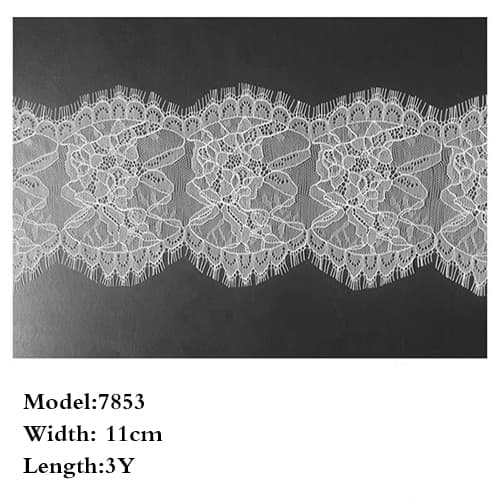
How Does Fiber Composition Affect the Drape of Black Eyelash Lace?
Fiber composition influences softness, flexibility, recovery, and resistance to deformation. These characteristics affect how the lace hangs and responds to movement during garment use.
Nylon Eyelash Lace
Nylon Eyelash Lace is often selected for its soft hand feel, flexibility, and suitability for delicate decorative applications. Depending on the yarn construction and knitting structure, it can create a lightweight lace with flowing fringes.
However, not every nylon construction has the same drape. Yarn fineness, filament structure, and fabric density can significantly change the final result.
Polyester Eyelash Lace
Polyester Eyelash Lace is commonly used when manufacturers need consistent production performance, durability, and dimensional stability. Its drape depends on yarn stiffness, filament arrangement, and fabric construction.
A relatively stiff polyester yarn may produce a more defined fringe appearance, while a finer and more flexible yarn can create a softer effect. Therefore, buyers should evaluate the finished material rather than assuming that all polyester lace has the same hand feel.
Stretch Eyelash Lace
Stretch Eyelash Lace contains elastic yarns or uses a construction that allows the fabric to extend and recover. Its drape is influenced by both the fabric's weight and its elastic behavior.
If the elastic component creates excessive resistance, the lace may follow body movement differently from a non-stretch construction. Manufacturers should consider both extension and recovery when evaluating the material for fitted garments.
How Can Manufacturers Test the Drape of Black Eyelash Lace?
Visual inspection is useful during sample development, but a more consistent testing method helps manufacturers compare different fabric constructions objectively.
A fabric drape test measures how a material hangs over a supporting surface and forms folds under its own weight. The drape coefficient is commonly used to describe the proportion of the fabric that remains outside the supporting area when the sample is allowed to hang.
A higher drape coefficient generally indicates a stiffer fabric with less pronounced draping, while a lower value generally indicates a more flexible material. However, the result should be interpreted alongside the actual fold shape and fabric construction.
For example, a manufacturer comparing two Black Eyelash Lace samples may record the following illustrative results:
| Property | Sample A | Sample B |
|---|---|---|
| Fabric weight | 65 GSM | 95 GSM |
| Thickness | 0.5 mm | 0.8 mm |
| Drape coefficient | 35% | 48% |
| Visual result | Softer folds | Fuller, more structured folds |
These figures are illustrative comparison data, not measured industry benchmarks. They demonstrate how weight, thickness, and drape can be evaluated together when selecting a suitable lace construction.
Which Fabric Weight Is Suitable for Different Black Eyelash Lace Applications?
The ideal fabric weight depends on the intended garment design rather than a universal GSM range.
Lightweight Eyelash Lace Fabric is often suitable for lingerie details, sheer garment overlays, and delicate decorative sections. Medium-weight constructions may be more appropriate for sleeves, garment inserts, and decorative panels that need a balance of flexibility and coverage.
Heavier constructions can be considered for wide decorative panels or applications where a fuller appearance is required. However, the finished garment should be checked to ensure that the additional weight does not pull down the surrounding fabric or affect wearing comfort.
For Wide Eyelash Lace, buyers should also consider how the material hangs across its full width. A wide lace panel may require consistent weight distribution to prevent one side from hanging differently from the other.
Does Fabric Weight Affect the Sewing and Finishing of Black Eyelash Lace?
Yes. Fabric weight can influence how easily lace is handled, positioned, and attached during garment production.
Lightweight lace may shift or stretch during cutting and sewing, especially when the ground structure is open. Heavier lace may be easier to position in some applications, but excessive weight can create bulky seams or affect the balance of lightweight garments.
For Eyelash Lace Edging and Eyelash Lace Embellishment, manufacturers should check whether the lace can be attached without changing its original drape or distorting the decorative fringe.
For example, when sewing a 10 cm wide lace panel onto a lightweight garment fabric, the sewing team should compare the panel's weight and flexibility with the base fabric. If the lace is substantially heavier, the garment may develop a pulled or uneven edge after assembly.
What Should Buyers Check Before Ordering Black Eyelash Lace?
GSM is an important specification, but it should not be the only selection criterion. Buyers should confirm several characteristics before approving a bulk order.
Fabric weight: Confirm the target GSM and acceptable production tolerance.
Thickness: Check whether the material has the required coverage and flexibility.
Fiber composition: Identify whether the product uses nylon, polyester, elastic yarn, or a blended construction.
Drape performance: Evaluate how the finished lace hangs and forms folds.
Fringe density: Check whether decorative yarns are distributed consistently.
Finished width: Confirm the usable width and edge construction.
Application suitability: Test the lace with the intended garment fabric before mass production.
Buyers sourcing Black Eyelash Lace Material for OEM or private-label garment production should request a finished sample that reflects the actual dyeing and finishing conditions. This provides a more reliable indication of how the material will behave during manufacturing.
Conclusion
Fabric weight affects the drape of Black Eyelash Lace by influencing how the material hangs, folds, and moves. Lightweight constructions often create a softer appearance, while heavier materials may produce fuller folds. However, thickness, bending stiffness, knitting structure, fringe density, and fiber composition also determine the final drape quality.
For garment manufacturers, fashion brands, and wholesale buyers, selecting the correct lace requires evaluating GSM together with physical flexibility and finished appearance. Comparing actual samples under consistent conditions is more reliable than choosing a material based on weight alone.
Whether sourcing Nylon Eyelash Lace, Polyester Eyelash Lace, or customized Eyelash Lace Textile, understanding the relationship between fabric weight and drape helps manufacturers achieve the intended garment appearance while maintaining comfort and production consistency.